Microworkers Fees vs Competitors: True Cost per Task
This site earns a commission if you sign up through its links (Hitworkers affiliate program). Code CHICO5 gives you +5% credits and reduces the commission from 12% to 7% on your account.
What to remember
- Microworkers: 10% approval fee ($0.10+ tasks), 7.5% below $0.10, charged only on approved work, $10 minimum deposit.
- Hitworkers: flat 10% fee already included in the displayed price, no subscription, rejected work refunded.
- MTurk (closed September 30, 2026): 20% fee, rising to 40% for batches over 10 assignments. No longer an option for new campaigns.
- A promo code can change the math: Hitworkers' CHICO5 gives the advertiser +5% in credits, but shifts the referrer's commission from 12% to 7%, worth knowing if you see that code elsewhere.
- Worked examples below show why "fee percentage" alone doesn't tell you the real cost per approved task.
I've been buying crowd tasks since 2017, mostly for labelling batches and quick QA checks, and fee structures are the first thing I check before loading money onto any platform. "10% fee" sounds simple until you ask what it's charged on, how approvals work, and what happens to rejected work. Here's how the main options actually compare once you do the math.
How does Microworkers calculate its fee?
Microworkers applies a 10% approval fee on tasks priced at $0.10 or higher, dropping to 7.5% on anything cheaper, and it only bills you once a submission is marked "Satisfied." Unpaid or rejected work doesn't carry the fee, since there's nothing to approve. You'll also need a $10 minimum deposit to activate an advertiser account, which is low enough to test the platform without much commitment.
This approval-based billing is the detail most comparisons skip. If your approval rate is low because instructions are unclear or the task is poorly designed, you pay less in fees, but you also get fewer usable results for the money you did spend. The fee percentage alone never tells the full story.
What does Hitworkers charge, and what do you actually see?
Hitworkers takes a flat 10% platform fee, but it's built into the price shown when you build a campaign, so there's no separate line item to track. There's no subscription either, and work that gets rejected is refunded rather than silently kept.
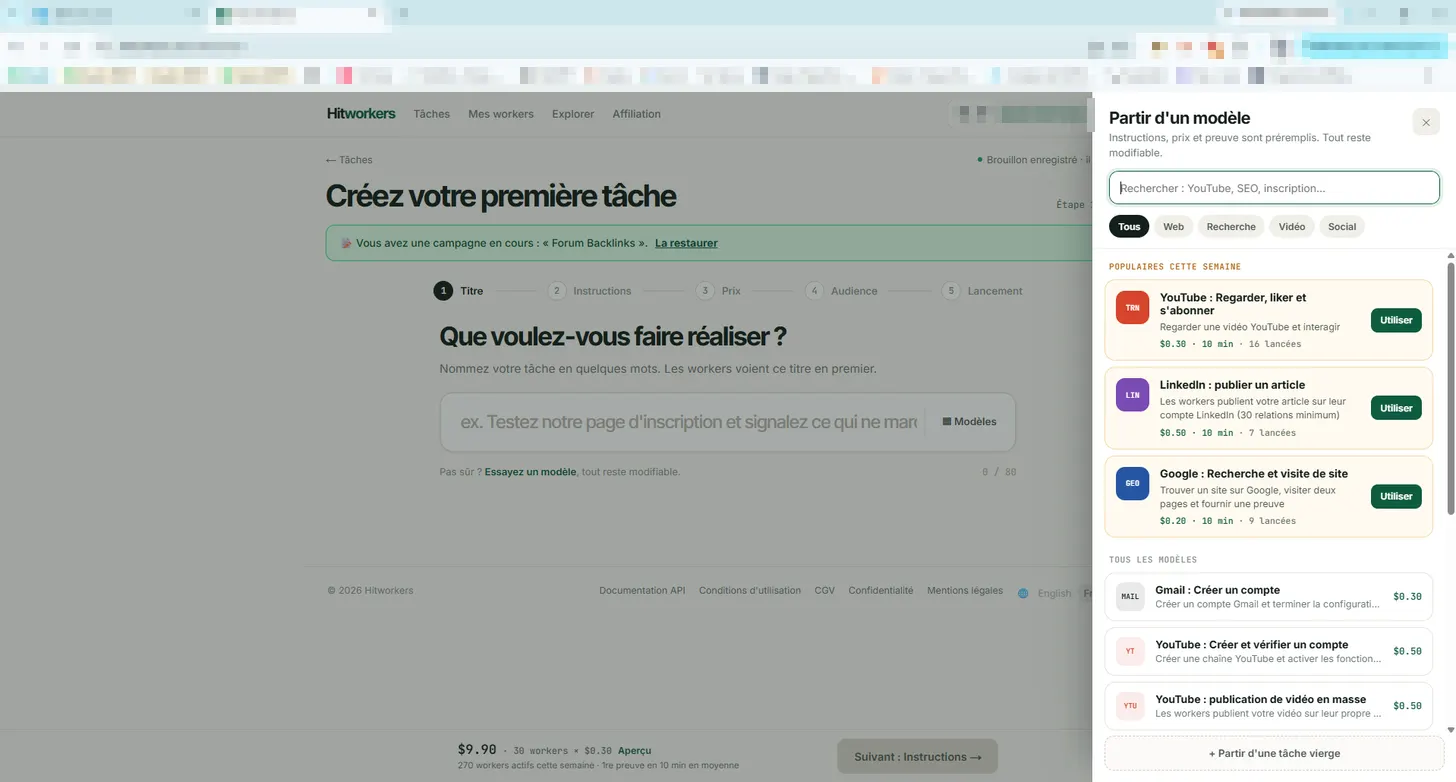
The campaign builder walks you through five steps: title, instructions, price, audience, and launch. One example I saw in the dashboard priced a campaign at $9.90 for 30 workers at $0.30 each, with the 10% fee already folded into that $0.30. That's a cleaner mental model than tracking a fee on top of your bid, since the number you type is the number you pay, full stop. For a broader side-by-side of what each platform offers beyond pricing, see this Hitworkers vs Microworkers comparison.
The dashboard also showed a temporary banner lowering the campaign minimum from 30 to 10 workers for seven days, useful if you just want to test a task type before committing to a full batch. Task templates cover things like watching and subscribing on YouTube, publishing on LinkedIn, running Google searches, or creating accounts, each with a suggested price per the platform's own benchmarks.
How did Mechanical Turk's fees compare before it shut down?
Before Amazon closed Mechanical Turk on September 30, 2026, requesters paid a 20% fee on top of worker payouts, and that jumped to 40% once a batch had more than 10 assignments. For anyone still running old integrations or migration docs, that math is now historical, but it explains why so many requesters were already shopping for alternatives before the shutdown. If you're one of them, this MTurk alternative guide covers where that traffic has been heading.
The step-function jump at 10 assignments was the part that caught people off guard. A 9-assignment batch and an 11-assignment batch could end up with meaningfully different effective costs per task, which made budgeting for larger campaigns harder than the headline 20% suggested.
What does a worked example look like side by side?
Numbers are easier to compare in a table than in prose, so here's how a simple task budget plays out under each fee structure using the figures each platform publishes or displays.
| Platform | Fee structure | Example task price | Fee charged on |
|---|---|---|---|
| Microworkers | 10% ($0.10+), 7.5% below | Set by advertiser | Approved ("Satisfied") tasks only |
| Hitworkers | Flat 10%, included in price | $0.30/task example (30 workers, $9.90) | Already included, rejected work refunded |
| Mechanical Turk (closed) | 20%, 40% over 10 assignments | Historical reference only | All assignments, fee tier by batch size |
The takeaway isn't that one percentage is universally lower. It's that "fee on approved work" versus "fee included upfront" versus "fee that scales with batch size" changes how you should budget a test campaign versus a large rollout.
Does the referral or promo code change what I pay?
Yes, and this is where transparency matters most. If you sign up through an affiliate link on this site, I may earn a commission on tasks you later run, at no extra cost to you. Hitworkers also offers a promo code system: using code CHICO5 gets you, the advertiser, an extra 5% in credits on your payments, but it also drops my commission on your account from 12% down to 7%. I'm telling you this because I'd rather you know the incentive than wonder about it later.
None of this changes the base 10% platform fee you see on your campaign. It only affects how credits and referral payouts are split behind the scenes, not the price you're quoted when you build a task.
Which platform fits a small test campaign best?
If you're running a handful of tasks to validate an idea, the $10 minimum deposit on Microworkers and the lowered 10-worker minimum on Hitworkers both make small-scale testing realistic without locking up much budget. Neither requires the kind of commitment that made MTurk's batch-size fee jump a real planning headache.
For a wider menu of options beyond these two, this roundup of platforms like Microworkers breaks down six choices by task type and approval speed, and the crowdsourcing platform buyer's guide covers what to check before committing a bigger budget.
What should I check before I fund my account?
Confirm whether the fee is charged on all submissions or only approved ones, check the minimum deposit or campaign size, and read how rejected work is handled since that's where real cost differences show up. A platform with a slightly higher headline fee but a generous rejection policy can end up cheaper per usable result than one with a lower fee and strict approval rules.
It's worth running a small test batch on more than one platform before committing a larger budget, since approval rates and worker response speed vary by task type in ways a fee schedule alone won't show you.
FAQ
Is the Microworkers fee charged on rejected tasks?
No, Microworkers only charges its approval fee on submissions marked "Satisfied." Rejected or unapproved work doesn't carry the 10% (or 7.5%) fee, since nothing was actually paid out for it.
What's the minimum I need to deposit to start on Microworkers?
Microworkers requires a $10 minimum deposit to activate an advertiser account, according to its own FAQ. That's low enough to run a small test batch before committing more budget.
Is Hitworkers' 10% fee on top of the price I set?
No, the 10% platform fee is already included in the price shown when you build a campaign, so the number you enter is the number you pay. There's no separate fee line added afterward.
Can I still use Mechanical Turk for new campaigns?
No, Amazon Mechanical Turk shut down permanently on September 30, 2026, so it's no longer an option for new requester accounts. Anyone still comparing its old 20% to 40% fees is doing so for historical reference only.
What happens if I use the CHICO5 promo code on Hitworkers?
You get an extra 5% in credits added to your payments as the advertiser. In exchange, the referring affiliate's commission on your account drops from 12% to 7%, which doesn't affect the price you're quoted.
Does a lower fee percentage always mean a cheaper campaign?
Not necessarily. A platform's effective cost per approved task depends on fee basis, approval rates, and rejection handling, not just the headline percentage.
Where can I compare Hitworkers and Microworkers directly?
See the Hitworkers vs Microworkers head-to-head for a feature-by-feature breakdown beyond fees alone.
Sources
- Microworkers FAQ — relevé le 08/11/2026
- SproutGigs — relevé le 08/11/2026
- Amazon Mechanical Turk (fermé) — relevé le 08/11/2026
- YouTube Test & Compare — relevé le 08/11/2026
- Companies House - MEDIASCALE LLP — relevé le 08/11/2026