Hitworkers vs Microworkers: Which One Fits Your Campaign?
This site earns a commission if you sign up through its links (Hitworkers affiliate program). Code CHICO5 gives you +5% credits and reduces the commission from 12% to 7% on your account.
What to know before you pick one
- Both charge you only for approved work: Hitworkers' 10 percent fee is already inside the displayed price, Microworkers' 10 percent (or 7.5 percent) fee applies to tasks rated "Satisfied."
- Microworkers has a lower deposit floor (10 dollars) and a longer track record across general micro-tasks.
- Hitworkers is built around five-step campaign templates (forum links, thumbnail tests, CTR, account creation) with a live worker count on the dashboard.
- Using the author's code CHICO5 on Hitworkers gives the advertiser 5 percent extra credit on payments, and drops the author's affiliate commission on that account from 12 percent to 7 percent, disclosed here for transparency.
- Microworkers runs "Standard" and "TTV" task types; Hitworkers has no subscription and refunds work it rejects.
I buy tasks on most crowd work marketplaces for labelling, surveys and QA, and I keep circling back to two names that show up in the same searches: Hitworkers and Microworkers. They solve different jobs even though people compare them as if they were twins. Here is what the two advertiser-side experiences actually look like, based on the published fee pages and screenshots from a live Hitworkers advertiser account.
What is each platform actually built for?
Microworkers is a general-purpose micro-task marketplace: surveys, app testing, data collection, sign-ups, anything a requester can describe as a short task for a worker anywhere in the world. Hitworkers is narrower by design, with templated campaigns aimed at SEO and video signals.
On the Hitworkers side, the template list I saw inside the advertiser dashboard includes TRN (watch and subscribe on YouTube, 0.30 dollars per 10 minutes), LIN (publish on LinkedIn, 0.50 dollars per 10 minutes), GEO (search on Google, 0.20 dollars per 10 minutes), plus account-creation templates for Gmail and YouTube, and public pages for forum backlinks and thumbnail testing. If your campaign fits one of those categories, the templated flow saves setup time. If it does not, Microworkers' free-form task builder is the more flexible tool, and so is this roundup of platforms similar to Microworkers if you want more than two options on the table.
How do the fees actually compare?
This is where people get confused, because both platforms say "10 percent" but mean different things by it.
| Item | Hitworkers | Microworkers |
|---|---|---|
| Platform fee | 10% included in the displayed price | 10% approval fee on tasks priced 10 cents or more (7.5% below that) |
| What triggers the fee | Charged on the price shown before launch | Billed only on tasks marked "Satisfied" |
| Minimum deposit / campaign | No stated deposit minimum; a temporary banner drops the worker minimum from 30 to 10 for 7 days | 10 dollar minimum deposit |
| Subscription | None | None mentioned on the fee page |
| Rejected work | Refunded | Not charged if not marked "Satisfied" |
| Task types | Templated (TRN, LIN, GEO, forum, thumbnail test, etc.) | Standard and TTV |
In practice, Hitworkers' all-in pricing is easier to budget from because the number you see at step 3 of campaign creation is the number you pay, with no separate line item added later. Microworkers' fee structure rewards requesters who approve efficiently, since you are only billed once a task clears review, but it means your real cost per task depends on your own approval discipline.
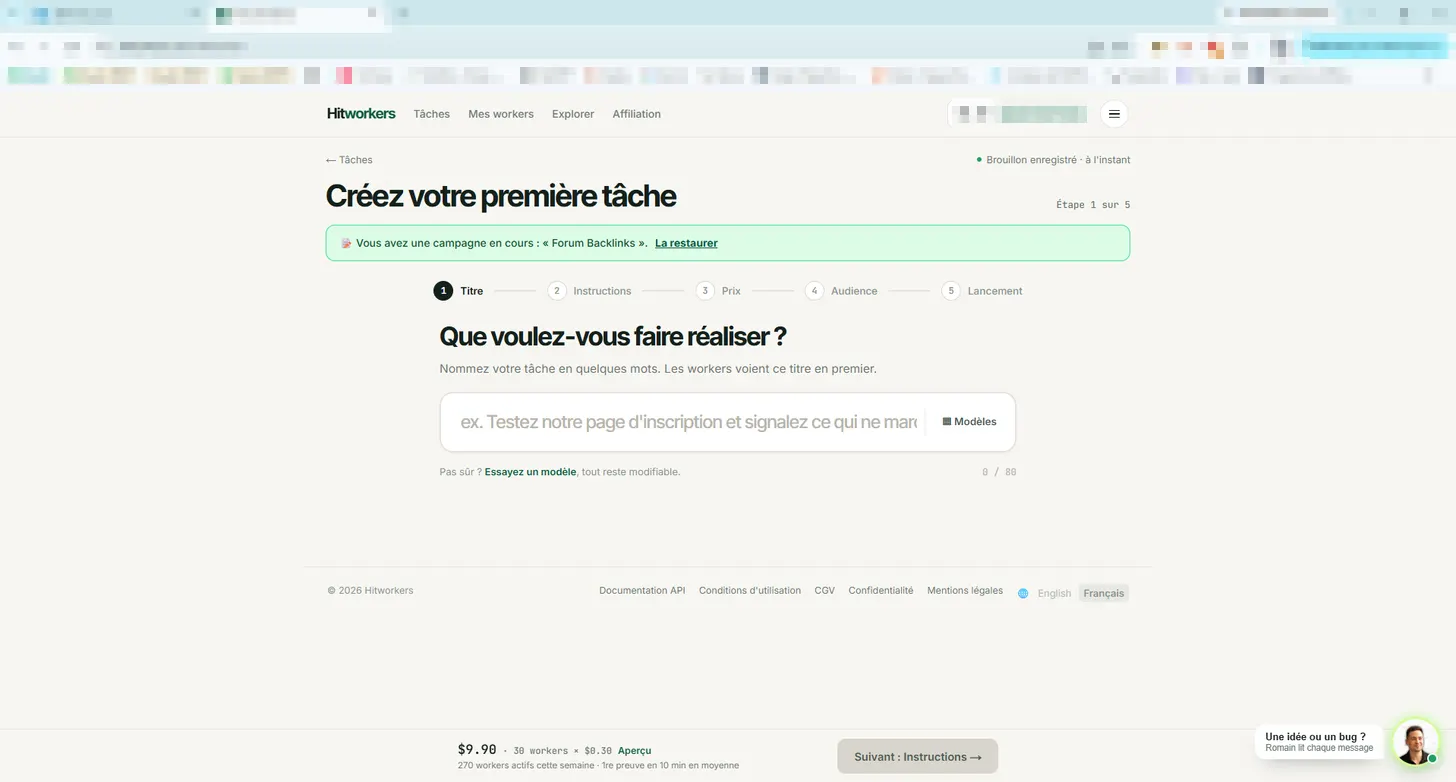
The screenshot above is from the Hitworkers campaign builder, step 3 of 5 (Price). The example shown on that screen is a 9.90 dollar campaign for 30 workers at 0.30 dollars each, with the 10 percent fee already folded into that total. The dashboard also displayed a live counter at the time I looked, "270 workers active this week, first proof in 10 minutes on average," and a temporary banner letting you launch from 10 workers instead of 30 for seven days. There is also a short "5-minute overview" video on the same dashboard if you prefer to watch the flow before building a campaign.
Which one is cheaper for a small test campaign?
If you only need a handful of actions to test a thumbnail or a forum post, Hitworkers' per-unit pricing (forum links from 0.50 dollars, thumbnail votes from 0.10 dollars) is transparent because the fee is already in that number. Microworkers' 7.5 percent fee on sub-10-cent tasks can look cheaper on paper but the 10 dollar deposit floor matters more for very small tests.
For a one-off, low-volume test, either platform can work; the deciding factor is usually whether your task fits an existing Hitworkers template or needs the free-form builder Microworkers offers. If your use case is genuinely different, it's worth reading how Microworkers' fees stack up against other competitors before committing a deposit.
Who should pick Hitworkers?
Hitworkers fits requesters running SEO-adjacent or video-signal campaigns who want a short setup path. The five-step flow (title, instructions, price, audience, launch) and the template library mean you can get a forum-link or watch-and-subscribe campaign live in a few minutes without writing your own task copy.
It also ships with an API and documentation that includes an MCP section for AI agents, which matters if you plan to automate campaign creation rather than click through the dashboard every time.
Who should pick Microworkers?
Microworkers makes more sense if your task does not map to a pre-built template, if you want to start with a smaller deposit, or if you need the "TTV" format for video-related tasks outside Hitworkers' specific templates. It is also the better starting point if you are coming from a search for an MTurk alternative after Mechanical Turk's shutdown, since it has a longer history of handling general-purpose task volume.
What about the Hitworkers affiliate code, honestly?
I use the Hitworkers affiliate program and I want to be upfront about the mechanics instead of burying them in fine print. Hitworkers pays affiliates 12 percent for life on an advertiser's approved task spend, calculated only on validated tasks and paid by bank transfer. My code, CHICO5, gives you as the advertiser 5 percent extra credit on your payments, but it also drops my commission on your account from 12 percent to 7 percent. I still use it because the discount benefits the person actually spending money on tasks, but you should know exactly how that trade-off works before you click through.
Anyone who signs up as an advertiser within 90 days of clicking an affiliate link stays attached to that affiliate for life, code or no code, so this isn't a one-time bonus decision, it's a lasting relationship with whichever link you use.
Does either platform help with YouTube thumbnail testing specifically?
Hitworkers' thumbnail test template starts at 0.10 dollars per vote, shows two to four thumbnails to real viewers, and asks for a choice plus a short justification, which gives you qualitative feedback fast. YouTube's own built-in Test & Compare tool, by contrast, tests up to three titles or thumbnails against real impressions on a published video and picks a winner based on watch time share over a few days to two weeks, but it never tells you why one option won and requires advanced features like phone or ID verification.
Microworkers does not have a dedicated thumbnail-test template; you would build a custom survey-style task instead, which takes longer to set up but gives you full control over the questions asked.
Is one of these platforms objectively safer to use?
Both are commercial marketplaces, not free tools, and neither guarantees a specific campaign outcome. Hitworkers is operated by Mediascale LLP, registered in England (Companies House number OC461663), and is a newer entrant than Microworkers, which has published fee documentation for longer and has an established worker base.
If your priority is working with forum links or CTR-style tasks specifically, it's worth comparing both against dedicated alternatives like SproutGigs before deciding which fits your risk tolerance and task type.
FAQ
Is Hitworkers cheaper than Microworkers?
Not exactly comparable on a single number. Hitworkers' 10 percent fee is baked into the price shown at campaign setup, while Microworkers charges 10 percent (or 7.5 percent under 10 cents) only on tasks marked "Satisfied," so your actual cost depends on your approval rate on Microworkers and is fixed upfront on Hitworkers.
What is the minimum I need to spend to try Hitworkers?
There is no stated deposit minimum on Hitworkers, but campaigns are normally built around a 30-worker minimum. A temporary banner on the dashboard currently drops that to 10 workers for seven days.
What is the minimum deposit on Microworkers?
Microworkers' own FAQ states a minimum deposit of 10 dollars to fund an account before running tasks.
Does the Hitworkers affiliate code actually save me money?
Yes, the code CHICO5 adds 5 percent extra credit to your payments as an advertiser. It also changes the affiliate's commission structure on your account from 12 percent to 7 percent, which does not cost you anything extra but is worth knowing.
Can I use Hitworkers for things other than SEO and YouTube?
Hitworkers' public templates are concentrated around forum links, CTR, thumbnail testing and account creation tasks, so it is narrower than Microworkers by design. For broader task types, Microworkers or a platform listed in this Picoworkers comparison will likely fit better.
Is Mechanical Turk still an option to compare against?
No, Amazon Mechanical Turk closed permanently on September 30, 2026, so it is no longer part of this comparison.
Does either platform refund rejected work?
Hitworkers states that rejected work is refunded. Microworkers' fee model achieves a similar effect by only billing tasks that reach "Satisfied" status, so unapproved work is not charged either way.
Sources
- Hitworkers public pages — relevé le 08/11/2026
- Microworkers FAQ — relevé le 08/11/2026
- SproutGigs pricing — relevé le 08/11/2026
- Amazon Mechanical Turk requester pricing — relevé le 08/11/2026
- YouTube Test & Compare — relevé le 08/11/2026
- Companies House, Mediascale LLP — relevé le 08/11/2026